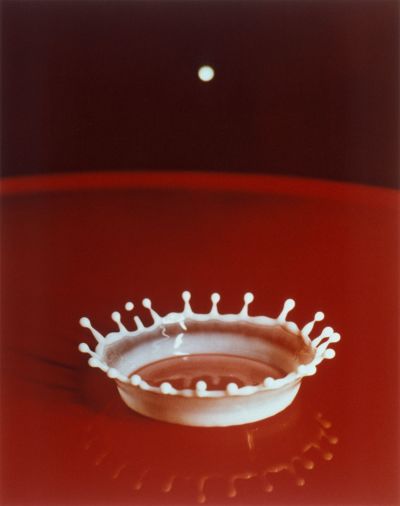
Doc told me some years ago that it took many tries to get this exact photo. He needed to get just the right amount of liquid on the table to have it all lift up in a crown that way. It’s a beautiful photo!
This color photograph was taken in 1957. An image taken in 1937 in black and white was published in Flash published in 1939. A beam of light and a photocell was used in both examples to trigger the flash after an adjustable electronic delay. A dropper produces a small drop following the main drop of liquid from the neck pinching off in two places. This small drop following the main drop is seen in the photograph of the splash made by the main drop. The drop of milk is splashing into the thin film of milk that has formed on the surface from the previous drop of milk. The shape of the coronet is very dependent on the thickness of the film of milk, the size of the drop, and the height through which the drop has fallen. Milk was selected as the liquid because it is white and translucent and attractive to photograph. Photographing splashes has a long history in particular see Worthington’s book on that subject using sparks as a light source and using two drops, one as part of an electrical switching arrangement to achieve the timing. My father’s contribution was his developments in the power and short exposure time of the electronic flash and his developing the methods of timing the flash using photocells and electronic delays.
Why is there no white cream inside the ring it makes? It’s a “crown” of pure white cream (with a ring of reddish on the inside) with no white in the middle.
Wow this is sooo stimulating. I enjoy taking pictures in my quick flash photo lab. I am thoroughly interested in seeing quick flash photography captured by true experts.
The interesting aspect for me is when the main mass of the ejecta reaches a critical point where it breaks into small independent spheres which are roughly equally distributed along the circumference. The the entire mass is arcing outwards under the forces of velocity and the Earth’s gravity. It would be interesting to see a similar experiment done in a zero gravity situation. Of course an alternative method would have to be devised to squirt the initial droplet at the target.
I met doc as a teenager and he gave me a signed post card of this image and a few others. One of the greatest people I ever met. As a photographer I can’t imagine life without a flash!!
I don’t drink milk but this image definitely has made me think twice about that white liquid thing. Haha! Brilliant! It really captured my attention. Stop and Shop, here I come!
wow amazing!!
this thing is made out of milk?
OMG!!
OMG WTF BTW, that looks like a crown made out of milk
amazing!!!!! its so cool that it can take that picture at the exact second!!!
Doc told me some years ago that it took many tries to get this exact photo. He needed to get just the right amount of liquid on the table to have it all lift up in a crown that way. It’s a beautiful photo!
it just needs cornflakes
wow i can’t belive that’s milk. i looks just like a crown, fit for the king, haha!
This color photograph was taken in 1957. An image taken in 1937 in black and white was published in Flash published in 1939. A beam of light and a photocell was used in both examples to trigger the flash after an adjustable electronic delay. A dropper produces a small drop following the main drop of liquid from the neck pinching off in two places. This small drop following the main drop is seen in the photograph of the splash made by the main drop. The drop of milk is splashing into the thin film of milk that has formed on the surface from the previous drop of milk. The shape of the coronet is very dependent on the thickness of the film of milk, the size of the drop, and the height through which the drop has fallen. Milk was selected as the liquid because it is white and translucent and attractive to photograph. Photographing splashes has a long history in particular see Worthington’s book on that subject using sparks as a light source and using two drops, one as part of an electrical switching arrangement to achieve the timing. My father’s contribution was his developments in the power and short exposure time of the electronic flash and his developing the methods of timing the flash using photocells and electronic delays.
Why is there no white cream inside the ring it makes? It’s a “crown” of pure white cream (with a ring of reddish on the inside) with no white in the middle.
That IS truly amazing! It does resemble a crown and it looks as though part of the edge of it has splashed upwards!
Simply L33t!
A Bottle of Pwnsauce, absolutely brilliant!
BBQ SAUCE
This is so cool. I love this museum and Boston. Thank you so much for putting this picture up here. It is cool.
I love this picture because its my favorite part
This looks like a crown made of ivory. Just a few diamond studdings and it will look gorgeous.
it lok’s like a crown made of milk made for the dairy queen haha
WOW!!! Thats amazing! I’d never get the timing right to take that pic!!! Totally cool!
wow how do they do that? and the most amazing part is that it is made of milk
^^ haha at the dairy queen comment .
WOW ! That’s cool (;
The reflection of the crown on the red background is such a metaphor! This photograph epitomizes the genius and artist of Dr. Edgerton.
milk in a bottle of cranerry juice
cool! very artistic
MILK!!!!!! Wow, that is cool!!!!! How did you do it?!
just amazing!! O..O
Simple answer to how it is done: the flash of light for the photograph is very, very short and at just the right time.
haaaaaaaaaallllllleeeeelllllUUUUUULLLLAAAAHHHHH!!!! praise the man who took this phot,,, what’s his name… yeh, well this is AAAAMMMAAAZINK
wow… awsome amazing in less than one seond and its perfect
I see life.
that is so cool it looks like a crown because of the drop of milk into the cranberry juice
It is amazing how the milk on the surface is orange and in the air it changes back.
that is so awesome its like a plate with a ball at the top
Wow this is sooo stimulating. I enjoy taking pictures in my quick flash photo lab. I am thoroughly interested in seeing quick flash photography captured by true experts.
its so nerdy!!!!!!!!!!!and i cant even tell what it is so ha.
Back then it must have taken very long to get that image… now it’s probably way easier to get this kind of shot because of the modern cameras…
wao!!
The interesting aspect for me is when the main mass of the ejecta reaches a critical point where it breaks into small independent spheres which are roughly equally distributed along the circumference. The the entire mass is arcing outwards under the forces of velocity and the Earth’s gravity. It would be interesting to see a similar experiment done in a zero gravity situation. Of course an alternative method would have to be devised to squirt the initial droplet at the target.
I see a thumb with a small shell on it with a marble droping
pearl shaped like a crown
I didn’t know it was made out of milk. I wish the milk in my fridge did that when I poured it. To bad!
It looks like an almot perfect crown made out of milk and cranberry juice.
Sorry LOL. Anyway this looks really cool props to the guy who did this
If its milk, why the heck is part of it red??????????
i noticed it
what is this?! its sooo cool!!
oh my god!! it’s awsome:))
I met doc as a teenager and he gave me a signed post card of this image and a few others. One of the greatest people I ever met. As a photographer I can’t imagine life without a flash!!
From Bridgett
it looks like a crown
coolio
I don’t drink milk but this image definitely has made me think twice about that white liquid thing. Haha! Brilliant! It really captured my attention. Stop and Shop, here I come!
This photo is incredible! It proprably took a lot of patience and practive to accomplish…….